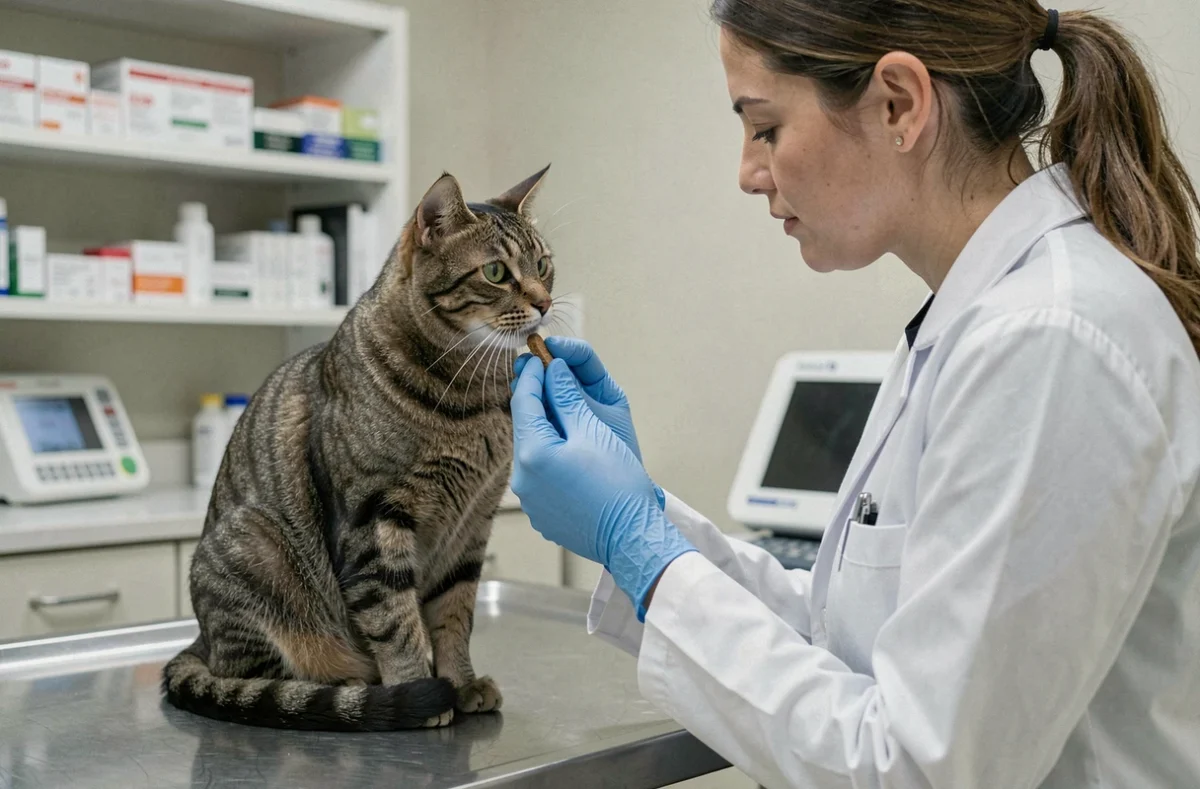
An indoor cat scratching its neck for three days, another one vomiting an ascaris on the very morning we planned to give it its flea tablet: we often find ourselves wanting to treat multiple parasites at the same time. Combining Credelio and a dewormer for the cat is a common situation, but it requires a few checks before opening both boxes on the same day.
Lotilaner and dewormer: two molecules, two distinct targets
Credelio contains lotilaner, a molecule from the isoxazoline family. Its spectrum covers fleas and ticks, but not intestinal worms. It is referred to as an ectoparasiticide: it acts on external parasites by blocking their nervous system, with no effect on the nematodes or cestodes that colonize the digestive tract.
The dewormer, on the other hand, targets internal parasites (roundworms, flatworms, and sometimes protozoa depending on the formulation). Therefore, the two products do not act on the same receptors or in the same compartments of the cat’s body.
This difference in target explains why, in the majority of cases, close administration does not pose a direct pharmacological problem. As detailed by the site L’Animal et l’Homme, the question is less about a chemical interaction than about the cat’s digestive tolerance and the monitoring of each treatment.
Credelio with food: a constraint that changes planning
Lotilaner needs a meal to be properly absorbed. Giving Credelio on an empty stomach reduces the absorption of the molecule, which can compromise the effectiveness of the treatment against fleas and ticks. The instructions recommend administering it during or just after a meal.

When adding a dewormer on the same day, this dietary constraint must be taken into account. Some dewormers are also given with food, while others are taken on an empty stomach for better efficacy. A one-size-fits-all rule cannot be applied.
In practice, three situations often arise:
- The dewormer is given on an empty stomach: it is given in the morning, and we wait for the next meal to administer Credelio with food.
- The dewormer is given with a meal: it is possible to give both tablets at the same meal, provided this point has been validated with the veterinarian.
- The cat vomits easily: we space the administrations by at least a few hours to identify which of the two products is responsible if a vomiting episode occurs.
Vomiting after administration: the double treatment trap
A cat that regurgitates a Credelio tablet poses a specific problem. A vomited tablet does not automatically justify a second dose. The decision depends on the time elapsed between ingestion and vomiting. If the tablet is expelled intact a few minutes later, the molecule has probably not been absorbed. If the cat vomits an hour later with no trace of the tablet, lotilaner may have entered the bloodstream.
When a dewormer and Credelio are given on the same day, identifying which product is causing the digestive issues becomes complicated. We sometimes observe loose stools or a vomiting episode without knowing which of the two is responsible.
The simplest precaution is to note the exact time of each administration. In case of vomiting, this information allows the veterinarian to decide whether to re-administer one or the other treatment, or to wait.
When to space the two treatments by a few days
For a cat with a sensitive digestive system (history of gastritis, elderly animal, cat on chronic treatment), spacing Credelio and the dewormer by two to three days reduces the risk of confusion in case of a reaction. We lose in practicality, but we gain in clarity if an adverse effect appears.
For a healthy cat, with no digestive or neurological history, many veterinarians accept administration on the same day. Tolerance varies according to the size of the animal, its age, and the chosen deworming molecule.
Cat’s neurological history and isoxazolines
Lotilaner belongs to the class of isoxazolines, for which neurological effects have been reported in cats: muscle tremors, coordination disorders, and more rarely seizures. These cases remain infrequent, but they do exist.
A cat with a history of seizures or neurological disease must be explicitly reported to the veterinarian before any prescription of Credelio. The addition of a dewormer, which can also cause temporary stimulation (agitation, hypersalivation depending on the molecule), reinforces the need for this prior assessment.
This is not an absolute contraindication for all cats, but a risk profile to check on a case-by-case basis. An epileptic cat will not necessarily receive the same antiparasitic protocol as a cat without such a history.
What the veterinarian checks before combining the two treatments
During the consultation, the practitioner examines several points before validating the combination:
- The exact weight of the cat, to adjust the dosages of each product without the risk of overdose.
- The ongoing treatments (anti-inflammatories, antibiotics, corticosteroids), as some combinations increase the hepatic load.
- The lifestyle of the animal: an exclusively indoor cat does not have the same antiparasitic schedule as a cat that hunts outdoors.
- The history of adverse reactions to previous antiparasitics.
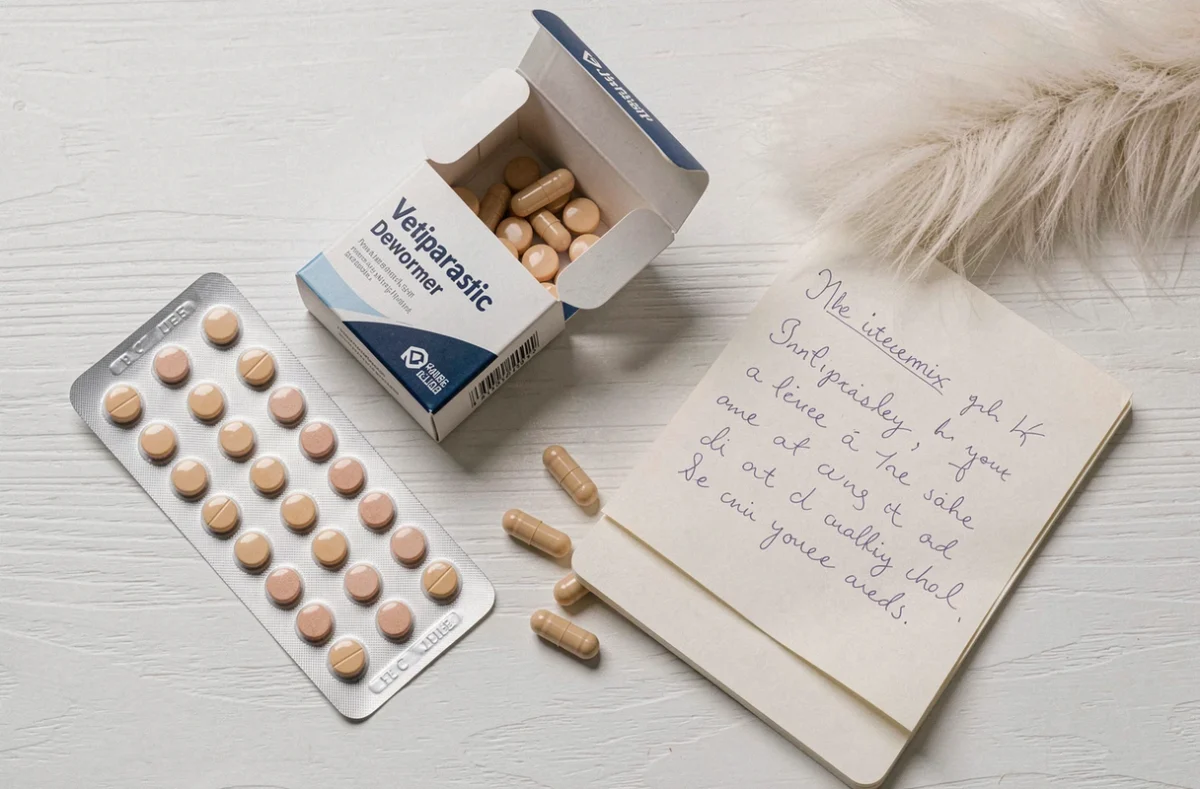
Antiparasitic schedule: coordinating Credelio and dewormer throughout the year
Credelio is generally given every month. The dewormer, depending on the lifestyle, is given every three to six months for an adult cat. Synchronizing the two treatments on the same schedule avoids forgetfulness and simplifies monitoring.
A pragmatic approach is to align the quarterly dewormer with one of the monthly doses of Credelio. On the chosen day, both products are given with the meal (or a few hours apart depending on tolerance), and then Credelio is given alone in the following months.
No product combining lotilaner and a deworming molecule exists in the Credelio range for cats. The two treatments remain separate, allowing the veterinarian to choose the deworming molecule best suited to each animal’s parasitic profile.
The combination of Credelio and dewormer does not pose major difficulties for most cats. The only precaution that truly changes the game is to respect the dietary intake for lotilaner and to keep a written record of the administration times, especially on days when both products are given together.