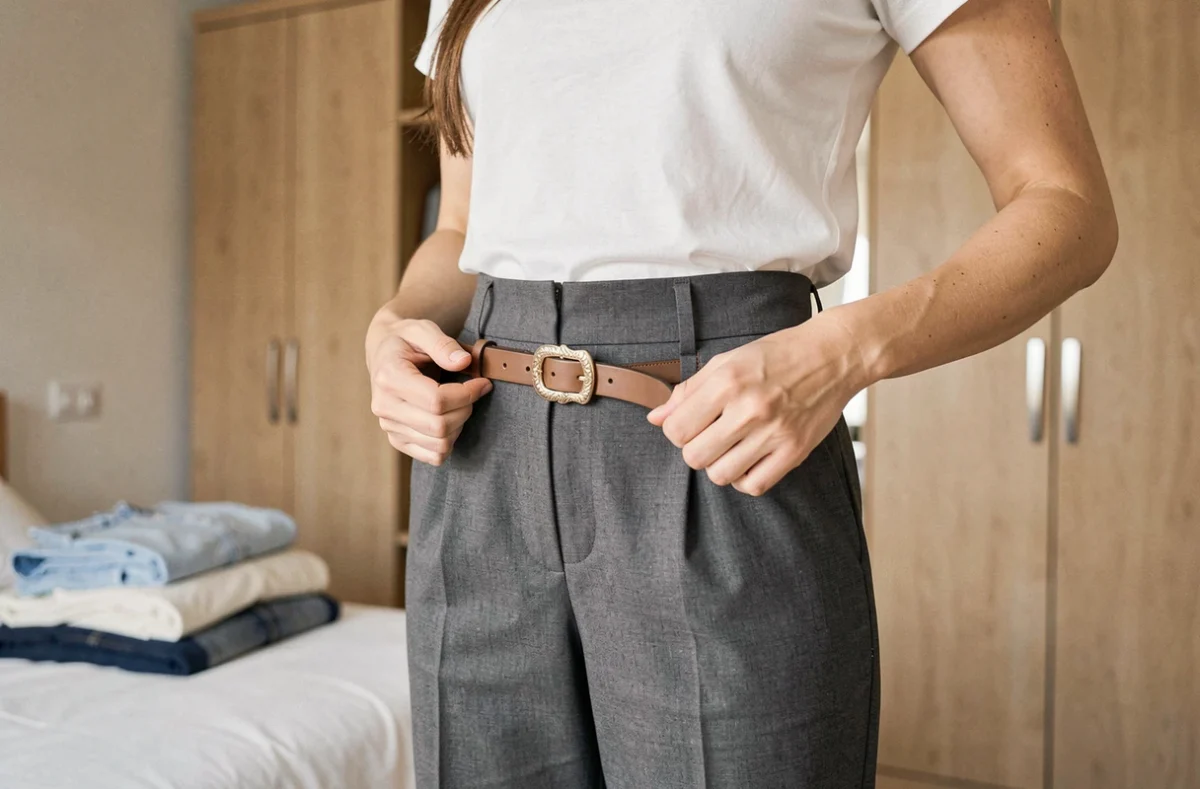
Some trousers, skirts, and dresses simply don’t have belt loops. Without these fabric loops to hold it against the waist, a belt slips, rides up, or twists around. Before giving up on the accessory or altering the garment, try one of several ways to secure a belt on clothing without loops, each suited to a particular fabric and purpose.
Why a belt slips without loops: the mechanics
Belt loops serve a simple purpose: they distribute the belt’s tension across several fixed points along the waist. Without them, the belt relies entirely on friction between the leather (or fabric) and the garment.
This friction depends on two factors. The first is the garment’s material: thick cotton or denim holds a belt better than satin or smooth polyester. The second is the fit: fitted trousers naturally keep a belt higher than a loose style, where the fabric hangs around the waist.
Without loops to distribute the tension, the belt presses directly against the fabric and can cause it to bunch. On a flowing garment, this creates unsightly creases. On structured fabric, the effect is less noticeable, but the belt tends to roll over itself at the back.
All the solutions below aim to create anchor points or increase friction. The right method depends on the fabric, how often you wear the garment, and the look you want. This detailed guide also explains how to wear a belt without loops by combining several of these approaches.
Belt clips: an invisible way to secure your belt
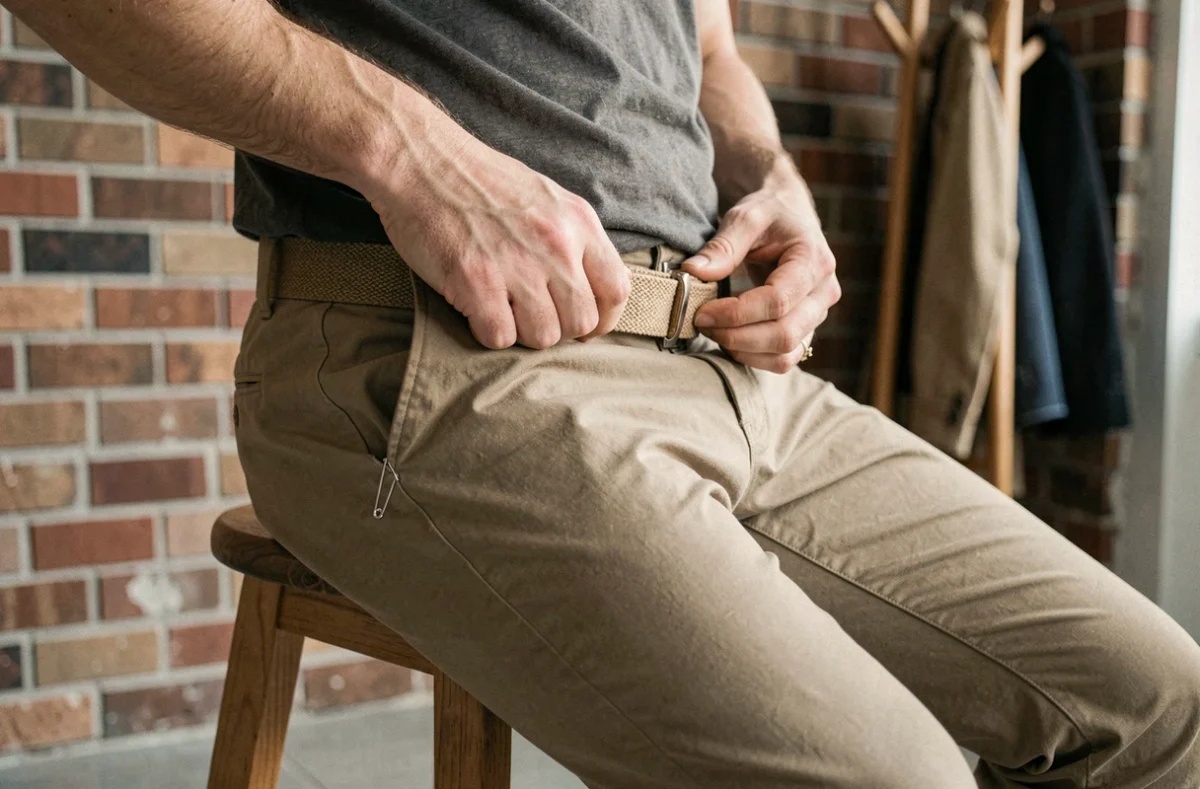
Belt clips are small metal fasteners that attach directly to the belt and hook onto the top edge of the garment. Their main advantage is that they’re almost invisible once in place.
How to position them
Place the clip on the inside of the belt, then use its jaw to grip the waistband of the trousers or skirt. Two clips are enough to hold the belt in place: position one on each side of the hips, slightly toward the back. On thin fabric, placing the clip over a seam or inner reinforcement helps prevent marks.
What to keep in mind
On very lightweight fabric (silk, chiffon), a clip can pull the garment down or leave a visible mark. This method is best suited to medium-weight fabrics such as cotton, linen, or lightweight wool.
Elastic or buckle-free belts: choose an accessory that suits the garment
Instead of forcing a traditional belt to stay in place on a garment that isn’t designed for one, choose a belt made to work without loops.
- A braided elastic belt fits snugly around the waist and applies constant pressure. Its flexibility prevents slipping, even on smooth fabric, because it moves with your body rather than staying rigid.
- A buckle-free belt (with a magnetic or flat-hook fastening) eliminates the excess length that would otherwise stick out and flap around. With no prong or keeper loop, the loose end stays in place.
- An automatic buckle belt (ratchet belt) allows for precise adjustment. It doesn’t require holes, and its even tension helps prevent sideways movement.
All three types of belt work for both men and women. The main thing to consider is the width: on a garment without loops, a narrow belt (2 to 3 cm) pulls on the fabric less than a wide one.
Everyday ways to secure a belt on trousers without loops
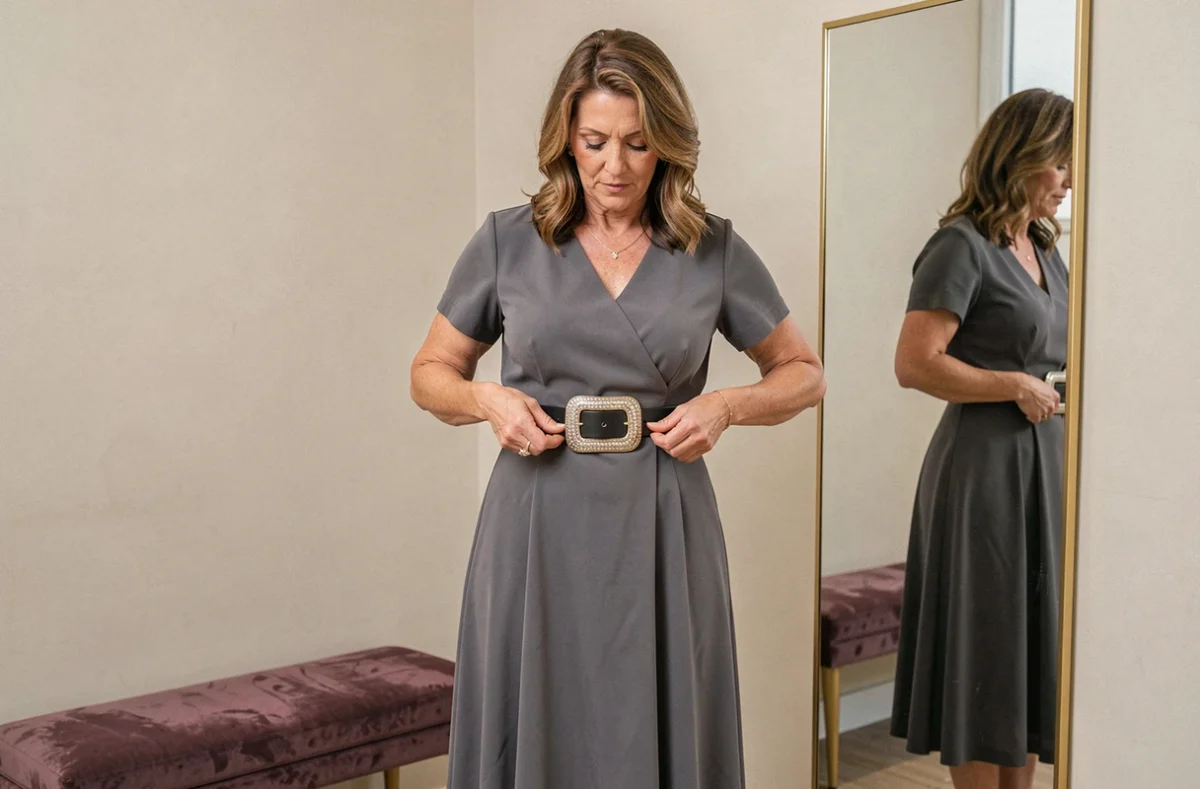
If you don’t have clips or a special belt, a few quick fixes can work with things you already have at home.
Use a hair tie as an improvised loop
Wrap a hair tie around the belt and fasten it to a waistband button to create a discreet anchor point. This trick works best at the front of the trousers, where there’s almost always a button. It only secures the belt at one point, but that’s often enough to stop it from twisting.
Double-sided fabric tape
Strips of fabric tape (such as hemming tape) stuck to the inside of the belt increase friction against the garment. They hold reasonably well on thick, dry fabric. However, sweat weakens the adhesive over the course of the day, and some adhesives leave residue on delicate fabrics. Test a small, discreet area on the inside of the garment before heading out to avoid any surprises.
Tie the belt
With a fabric or soft leather belt, a flat knot at the front turns a functional accessory into a style detail. The knot keeps the belt in place without any fastening system. This method works well with dresses and high-waisted trousers, but it adds bulk around the stomach, which may not suit every figure.
Waist alterations: a lasting fix for trousers that are too loose
If trousers without loops gape at the waist, no clip or quick fix can replace having the waistband itself altered. Taking them to a tailor usually costs less than buying a quality belt, and the result is permanent.
This alteration makes sense if you wear the garment regularly. Tightening a belt around unreinforced fabric can deform the garment over time. For trousers with an elastic waistband or side adjusters, it’s better to use the built-in adjustment system, which distributes tension evenly.
Suspenders are another option. They hold up the trousers from the shoulders, eliminating the need for a belt. Clip-on styles require no alterations, while button-on styles need interior buttons sewn on by a tailor.
Whether to use a belt secured with an accessory, a self-gripping belt, or no belt at all depends on the garment, the occasion, and the comfort you’re looking for. Dress trousers without loops are better suited to suspenders or an alteration. Casual trousers work well with a clip or an elastic belt. The best solution is one that doesn’t distort the garment and stays in place all day.