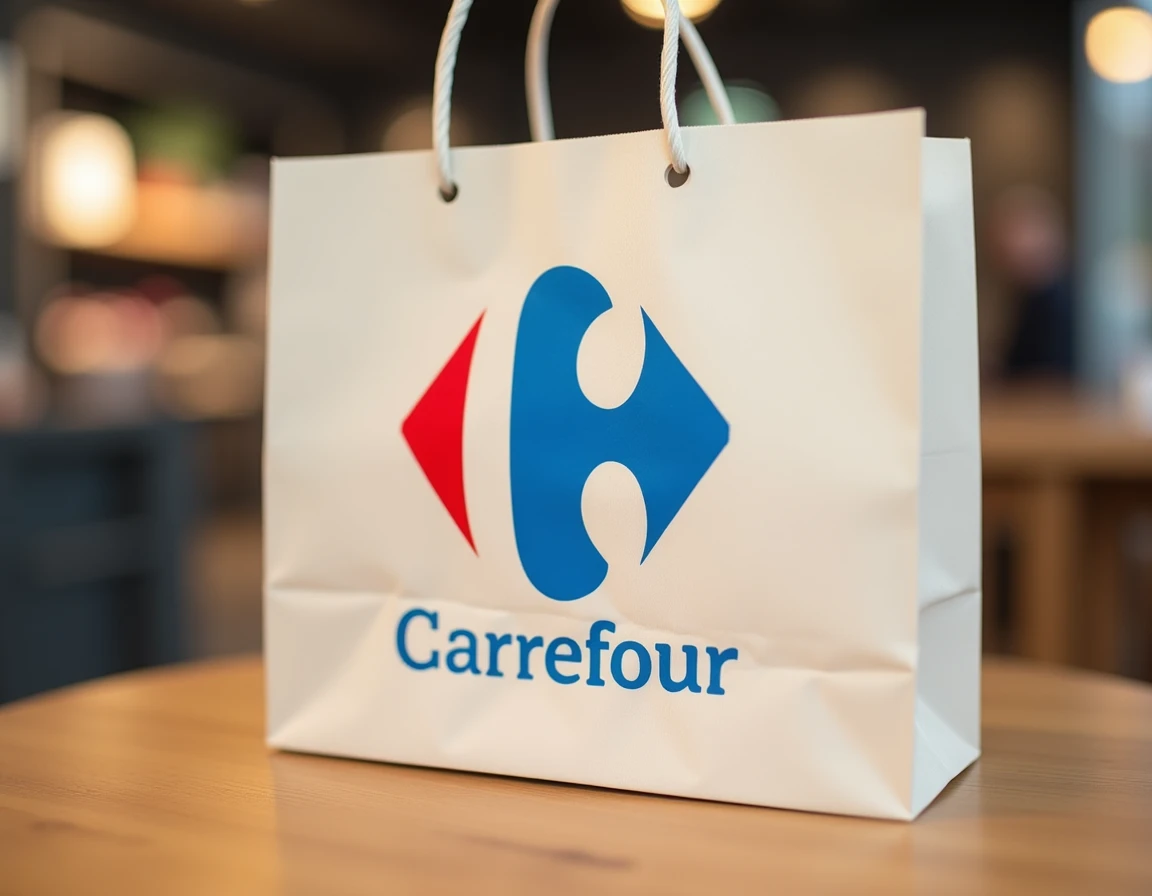
The Carrefour logo is based on a design principle called negative space: two colored shapes, a red arrow and a blue arrow, frame a white void that forms the letter C, the initial of the brand. This graphic mechanism, developed in 1966 by designer Jacques Daniel, remains one of the most studied examples of dual-meaning visual identity in the retail sector.
The role of designer Jacques Daniel in the creation of the Carrefour logo
Before 1966, the brand founded in 1959 in Annecy by the Fournier, Badin, and Defforey families used simple lettering without a distinctive symbol. The first logo was limited to the word “Carrefour” written in capital letters, sometimes accompanied by directional arrows suggesting a crossroads.
Jacques Daniel introduced a clear break. His idea was to merge two opposing arrows, pointing left and right, within a diamond shape. The space left between these two arrows reveals a white C, visible only when the gaze adjusts. To delve deeper into the evolution of the Carrefour logo and the meaning of its symbol, this dual reading remains the technical entry point to master.
This process relies on the laws of Gestalt, a set of perceptual principles according to which the human brain spontaneously completes missing shapes. The C is not drawn anywhere: it is born from the contrast between the colored areas and the white background.
Symbolism of the blue and red colors of the Carrefour logo

The choice of blue and red is not trivial. These two colors directly refer to the French flag, and this chromatic connection anchors the brand in a strong national identity. For a brand born in the French Alps, this reference played a role in differentiation at a time when retail was beginning to internationalize.
Blue evokes trust and stability. Red conveys energy, action, and urgency to buy. Combined in a compact diamond, they create a strong enough contrast for the eye to identify the logo from a distance, on a facade or a roadside sign.
Opposing arrows and the notion of a crossroads
The two arrows pointing in opposite directions literally reflect the name of the brand. A crossroads is a point of convergence. Graphically, the left arrow (blue) suggests origins and grounding. The right arrow (red) points to the future and expansion. This directional duality between past and future is directly coded into the geometry of the symbol.
The diamond that frames everything adds a dimension of stability. Unlike a circle (perpetual movement) or a square (rigidity), the diamond combines vertical dynamism and lateral balance.
Adaptations of the Carrefour logo for digital media
The institutional version of the logo, with the word “Carrefour” under the diamond, works on store facades or large posters. On a smartphone screen or a browser favicon, this composition becomes unreadable.
Since the early 2020s, Carrefour has been using simplified versions of the diamond without the word-symbol on its mobile apps and social media profiles. The diamond alone, with its two arrows and the C in negative space, is sufficient for identification. The thickness of the shapes has been increased to remain legible at very small sizes.
This simplification work falls under a specific area of design called responsive branding: adapting a logo to various display contexts without losing its recognition. Several technical elements come into play:
- Reducing the number of details to maintain readability on surfaces of a few square pixels
- Enhancing the color contrast between blue, red, and white to compensate for loss of resolution
- Removing the textual baseline in favor of the pictogram alone, which is more memorable in an application context
The logo as a vector for the “Act for Food” strategy
Starting in 2018, Carrefour launched the “Act for Food” tagline, focused on food transition, traceability, and product quality. This strategic orientation has given a societal dimension to the logo, which now goes beyond mere commercial identification.
The blue-white-red diamond no longer signals just a point of sale. It becomes the visual support of a commitment: responsible sourcing, reduction of packaging, promotion of organic products. This recontextualization shows that a logo does not necessarily change shape to change meaning. The same graphic symbol carries a different message depending on the accompanying brand platform.
International coherence and local adaptations
Carrefour operates in about twenty countries. For a long time, local subsidiaries (Brazil, Spain, Italy) had some latitude to adapt the typography or baseline of the logo. Since the early 2020s, the group has initiated a harmonization to bring all versions closer to the French standard.
This convergence aims to build a unified global brand while keeping the diamond as a common visual anchor. The result: a consumer in São Paulo or Milan recognizes the same symbol as a Parisian customer.
- Typography aligned with the French version in most markets
- Gradual abandonment of local baselines in favor of a unique corporate signature
- Systematic preservation of the diamond and its play of negative space, regardless of the country
The Carrefour logo remains a case study in graphic design because it concentrates multiple layers of meaning within a simple geometric form. The hidden letter, the national colors, the directional arrows: each element serves a specific function. Its longevity is less about immobility than about this density of meaning, which allows the same symbol to carry successive brand strategies without ever needing to be redesigned from scratch.