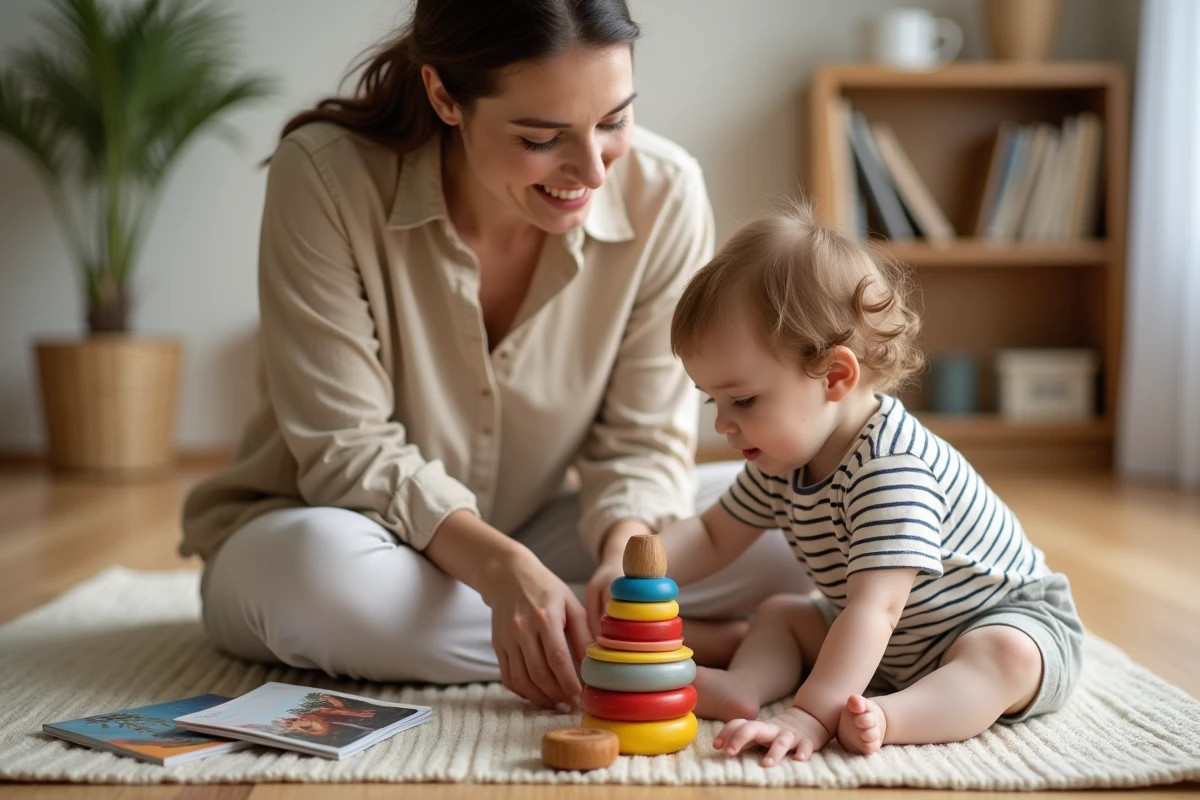
A two-year-old child who refuses to eat alone, another four-year-old who still doesn’t pronounce certain sounds: these everyday situations often generate concern. Supporting a child’s development starts with learning to observe what is actually happening, then adjusting responses accordingly. We review the effective strategies for daily life and the common mistakes to avoid.
Daily Routines and Child Development: Structure Before Stimulation
It is often thought that one must multiply activities to stimulate a child. In practice, the consistency of routines matters more than the quantity of activities. Bath time, meals, and getting dressed are moments when the child develops fine motor skills, language, and autonomy, provided they are given the time to do so.
A concrete example: at mealtime, an eighteen-month-old child holding their spoon is working on their hand-mouth coordination. We can name the foods, describe the textures. This is not an additional activity to fit into the day; it is everyday life transformed into a learning ground.
To explore this topic further, Parlons Enfance resources offer guidelines tailored to each age group. The challenge is not finding ideas, but resisting the urge to do things for the child when they take too long.
Symbolic Play and Emotions: What Parents Often Underestimate

Feeding a stuffed animal, playing shopkeeper, inventing a scenario with figurines: symbolic play is far from trivial. A study from the University of Sydney published in 2025 highlighted a decrease in behavioral issues in primary school among children exposed early to non-directive imaginative play.
This type of play allows the child to reenact situations that have unsettled them (a separation, a quarrel, a visit to the doctor) and to emotionally distance themselves from them. Symbolic play acts as a space for emotional regulation long before the child can verbalize their feelings.
In practice, this means allowing the child to direct the scenario. We can participate if they ask, but without correcting the story or imposing adult logic. A cardboard box, a few everyday objects, and an available parent are enough. Structured educational games have their place, but they do not replace this form of free exploration.
When Free Play Doesn’t Happen
Some children do not spontaneously engage in symbolic play. This is common among children who are heavily engaged with screens or those who are not used to playing without instructions. You can initiate the situation by starting a mini-scene with two objects yourself, then passing the lead to the child.
Responses vary on this point: some children latch on within a few days, while others need several weeks. The goal is not to turn free play into a mandatory exercise.
Child Language Development Between Six Months and Three Years: Concrete Guidelines for Parents
Language development is the topic that generates the most consultations with early childhood professionals. In Quebec, public health services have been providing individualized language advice kits to parents since 2025, designed to prevent language delays before they set in.
In France, the trend is similar. The guide “Les clés de l’enfance 0-3 ans,” published by the High Commissioner for Childhood in 2025, encourages the integration of early parental guidance programs in PMI consultations, including before any formal diagnosis.
Specifically, here are the key strategies that emerge from these programs:
- Name objects and actions as they occur, rather than asking closed questions (“What is that?”) that put the child in a testing situation.
- Rephrase what the child says by enriching the sentence: if they say “water,” you can respond, “You want some cold water in your glass.”
- Read together every day, even for a few minutes, allowing the child to turn the pages and comment on the pictures in their own way.
- Reduce background noise (television, constant music) during interaction times, as ambient noise decreases the child’s ability to isolate language sounds.

Child Autonomy: Accepting Slowness to Gain Skills
A three-year-old child putting on their shoes can easily take five minutes. The temptation to do it for them is strong, especially in the morning. This understandable reflex, however, hinders the acquisition of autonomy.
Allowing the child to fail and try again is part of the support. This applies to dressing, but also to tidying up, small age-appropriate household tasks, or choosing between two options (which sweater, which fruit). These micro-decisions build self-confidence much more than repeated compliments.
Here are some guidelines for integrating autonomy into daily life without conflict:
- Allow extra time in routines (leave ten minutes earlier in the morning) rather than eliminating learning opportunities.
- Adapt the environment: a step stool in the bathroom, clothes that are easy to put on, shelves at child height.
- Value effort more than results: “You managed to zip up your zipper” counts more than “That’s good.”
Supporting a child’s development does not rely on a program to be followed to the letter. It is based on regular attention to each child’s real needs in ordinary situations. Everyday life remains the best development ground, provided time and patience are allowed.